


A Washington Enhanced Driver License (EDL) is a federally approved, border-ready credential that lets you drive, prove your identity, and cross back into the U.S. by land or sea from Canada, Mexico, and the Caribbean without a passport. It costs more than a standard license, requires proof of U.S. citizenship, and satisfies REAL ID rules for boarding domestic flights. Most Washington residents who travel across the northern border choose it for exactly that convenience.
Washington is one of only a handful of states that issues an EDL, so the rules here are specific and worth getting right before you head to a licensing office. Below is the current picture of what the card does, who needs one, what you’ll bring to apply, what it costs, and how it stacks up against a REAL ID. We also cover what these RFID-equipped cards mean for businesses that verify identity at the door or the dock.
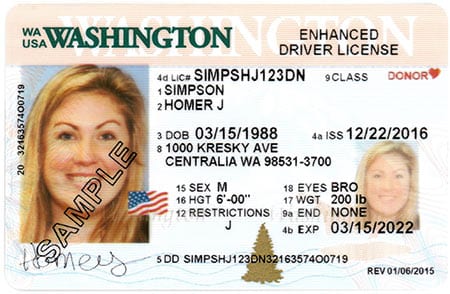
A Washington EDL is a standard driver license with two added federal capabilities. It proves U.S. citizenship and it works as a WHTI-compliant travel document. The same applies to the Enhanced ID Card (EID) for residents who don’t drive. Both are issued by the Washington State Department of Licensing.
The RFID chip doesn’t store your personal details. It holds a unique reference number that links to your record in a secure government database, which is why the card ships with a protective sleeve to shield it when you’re not crossing a border.
You need a Washington EDL if you’re a U.S. citizen and Washington resident who wants to cross the U.S. land or sea border without carrying a passport. It’s built for frequent northern-border travelers, and Washington’s proximity to British Columbia makes it a popular choice.
Consider an EDL if you:
An EDL may not be the right fit if you:
If you rarely leave the country by land or sea, a standard REAL ID-compliant license covers domestic flights and federal building access at a lower price.
Because an EDL certifies both your identity and your U.S. citizenship, the documentation is more involved than a standard renewal. You’ll apply in person at a licensing office, and the Department of Licensing verifies each document before issuing the card.
You’ll generally need to prove four things:
Bring original or certified documents; the office won’t accept photocopies for the citizenship and identity checks. Because exact accepted-document lists and any name-change paperwork can change, confirm the current list on the Washington DOL enhanced license page before your visit so you only make one trip. New applicants who don’t already hold a Washington license should also be prepared to complete standard licensing steps.
An EDL costs more than a standard Washington license because of the added citizenship verification and travel functionality. The Department of Licensing charges a per-year fee for the enhanced upgrade on top of the base licensing cost, and the card is issued for a multi-year term.
Fees are set by the state and are adjusted from time to time, so check the current EDL/EID fee schedule on the Washington DOL site before you apply. [VERIFY, current Washington EDL/EID fee and license term] The practical takeaway: budget for a modestly higher fee than a standard license in exchange for skipping a separate passport for land and sea crossings.
Both an EDL and a REAL ID let you board domestic flights and enter secure federal facilities, but they aren’t the same credential. The short version: a REAL ID gets you through airport security; an EDL does that and crosses the land or sea border. Here’s how they compare.
| Feature | Enhanced Driver License (EDL) | REAL ID |
| Boards domestic flights | Yes | Yes |
| Enters secure federal buildings | Yes | Yes |
| Crosses U.S. land/sea border (Canada, Mexico, Caribbean) | Yes | No |
| Valid for international air travel | No (passport required) | No (passport required) |
| Proves U.S. citizenship | Yes | No |
| Available to non-citizens | No | Yes |
| Contains RFID for border crossing | Yes | No |
| Cost | Higher | Standard |
Since REAL ID enforcement is now in effect for domestic air travel, every adult flyer needs either a REAL ID-compliant license, an EDL, a passport, or another accepted document to board. An EDL satisfies that requirement, so a Washington EDL holder is covered at the airport and at the border with a single card. If you never cross a land or sea border, a standard REAL ID meets your needs for less.
An EDL carries visible and machine-readable markers that set it apart from an ordinary license, and knowing them matters both for travelers and for businesses that verify IDs.
For a business, that combination is worth understanding. As states keep rolling out new and enhanced designs, the front of a card gets harder to read by eye, and counterfeiters keep pace with the visible features. That’s why the data encoded on the back, and the ability to check it, has become the reliable part of the verification.
For any business that checks IDs, Washington’s EDL is one more design your staff has to recognize and one more reason to stop relying on the human eye alone. A door person can’t feel an RFID chip or confirm a flag icon is genuine mid-rush, and a convincing fake can copy the look of an enhanced card.
We’ve spent 25+ years at TokenWorks helping businesses verify identity, and the pattern is consistent: fakes have gotten good enough that visual inspection misses them. A purpose-built ID scanner reads the PDF417 barcode on the back and validates its structure in seconds, so your staff aren’t guessing whether a Washington EDL, a REAL ID, or an out-of-state card is legitimate.
Different situations call for different depth:
Whatever the setting, the goal is the same: take the judgment call off your staff’s shoulders and put a documented, repeatable check in its place. That’s how you stay compliant and reduce the risk a good-looking fake slips through.
Always confirm the current requirements and fees directly with the Washington State Department of Licensing before you apply, since state rules change.
You must be a U.S. citizen and a Washington resident, and you’ll prove citizenship, identity, your Social Security number, and residency in person at a licensing office. Non-citizens don’t qualify for an EDL and should apply for a standard REAL ID instead.
Yes. The card holds an RFID tag that stores a unique reference number, not your personal information, which border officers use to pull up your record at a crossing. It comes with a protective sleeve that shields the tag when you’re not at a border.
Modern licenses, including EDLs, carry a PDF417 barcode on the back that an ID scanner reads and validates in seconds. Scanning is far more reliable than a visual check because it reads data a counterfeit is less able to fake, and it creates an audit trail that supports compliance.
Have questions about verifying enhanced licenses, REAL IDs, and out-of-state cards at your business? Speak with an expert about the right scanner for your door or counter, backed by 25+ years of U.S.-based support and a 30-day money-back guarantee.