


Vermont issues its driver’s licenses and ID cards as vertical cards to holders under 21 and as horizontal cards to everyone else. A small star inside a circle in the upper-right corner shows a card is REAL ID compliant. REAL ID and non-REAL ID licenses cost the same at the DMV, and businesses can check either one at a glance and confirm it with a scan in seconds.
We’ve helped more than 20,000 businesses check IDs over 25+ years at TokenWorks (IDscanner.com), and Vermont cards come up at bars, liquor stores, vape shops, dispensaries, and events across New England. This guide covers what the current card looks like, how REAL ID works in Vermont, what you’ll need to get one, and how your staff can verify a Vermont ID with confidence.
This guide is informational and isn’t legal advice. Always confirm current requirements with the Vermont Department of Motor Vehicles.
Vermont replaced a card design that had been in use since 2004. The DMV rolled out the current generation in 2019, and it moved card production to a central, high-security facility instead of printing cards at the counter.

That change affects what a new card holder actually carries:
Like most modern state IDs, the Vermont card layers several security features. Some are visible to the naked eye, some show up only at an angle, and others require ultraviolet light or a scanner to see. The back carries a 2D barcode that encodes the cardholder’s data in the standard format used across North American IDs.
We deliberately keep this description general. Detailed breakdowns of security features mainly help counterfeiters, and the practical takeaway for your business is simpler: today’s fakes can copy what the human eye checks, so the features that matter most are the ones a forensic scanner reads.
A Vermont REAL ID is a license or ID card that meets the federal REAL ID Act’s identity-verification standards. A standard (non-REAL ID) card, which the DMV calls a Driver’s Privilege Card (DPC), is still a valid Vermont license for driving and state purposes, but it isn’t accepted for federal purposes such as boarding a domestic flight. A third option, the Enhanced Driver’s License (EDL) or Enhanced Non-Driver ID (EID), is REAL ID compliant and also works as a border-crossing document.
The quickest way to tell them apart is the marker. According to the Vermont DMV’s REAL ID page, a circle with a star in the upper-right corner means the card is REAL ID compliant. Under Act 66, signed in June 2025, a non-REAL ID license or permit (the Driver’s Privilege Card) must bear the phrase “non-Real ID” on its face, along with text saying it isn’t valid for federal identification or official purposes. That rule took effect July 1, 2025. Before then, the law called for the phrase “privilege card,” so older cards may carry that wording. A non-REAL ID non-driver ID card isn’t covered by that change, but it must also state on its face that it isn’t valid for federal identification or official purposes.
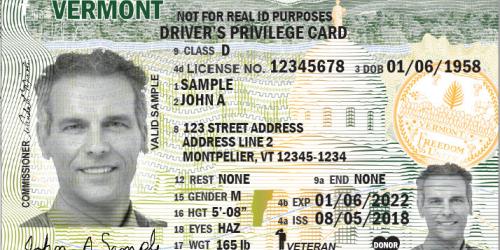

| Feature | Vermont REAL ID | Vermont Standard License (Driver’s Privilege Card) | Vermont Enhanced License or ID (EDL/EID) |
| Visible marker | Star in a circle, upper right | No star. Licenses and permits say “non-Real ID” (older cards may say “privilege card”). Non-driver IDs say they aren’t valid for federal identification or official purposes. | Enhanced designation |
| Domestic flights (TSA) | Accepted | Not accepted (bring a passport or other TSA-accepted ID) | Accepted |
| Federal facilities | Accepted | Not accepted (bring a passport or other accepted ID) | Accepted |
| Land and sea border crossings (Canada, Mexico, the Caribbean, Bermuda) | Not a border document | Not a border document | Accepted |
| Available as a Non-Driver ID | Yes | Yes | Yes (EID) |
| 2-year license fee | $39 | $39 | $75 (EDL) |
| 4-year license fee | $62 | $62 | $98 (EDL) |
Since federal REAL ID enforcement began on May 7, 2025, travelers 18 and older need a REAL ID compliant card or another TSA-accepted document, such as a passport, to board domestic flights. TSA’s list of acceptable IDs shows the alternatives.
If you’ve just renewed and need to fly, note that TSA won’t accept Vermont’s paper temporary document on its own. According to the DMV, TSA will accept it together with your expiring or expired card as proof of renewal. A paper temporary issued for an enhanced license or ID also can’t be used to cross the border.
For age verification at your door or counter, the star doesn’t change anything. A non-REAL ID Vermont card, including one marked “non-Real ID,” proves age just as well as a REAL ID. That wording only means the card isn’t valid for federal purposes, so your staff shouldn’t turn a customer away because of it. What your team should focus on is the birth date, the expiration date, and whether the card is genuine.
One cost detail worth knowing: REAL ID and standard licenses cost exactly the same in Vermont, so there’s no fee penalty for upgrading. The EDL costs more because it doubles as a border-crossing document. We covered how enhanced licenses work in our Washington enhanced driver’s license guide.
To issue a REAL ID, the Vermont DMV must verify four things about you:
Bring original or certified documents for each category. The DMV publishes the full list of accepted documents on its identity documents page, and we recommend checking it before your visit, since the list can change.
A standard license doesn’t carry the federal verification, and that has a practical consequence: if you hold a non-REAL ID card, you’ll need to provide all required documents again each time you renew or replace it. Upgrading to REAL ID once saves that step later.
These are the fees the Vermont DMV currently lists:
| Credential | Term | Fee |
| Driver’s license (REAL ID or standard) | 2 years | $39 |
| Driver’s license (REAL ID or standard) | 4 years | $62 |
| Driver’s license replacement | n/a | $24 |
| Driver’s license, reduced fee (SSI, SSDI, or disability) | 4 years | $20 |
| Reduced-fee driver’s license replacement | n/a | $10 |
| Enhanced Driver’s License | 2 years | $75 |
| Enhanced Driver’s License | 4 years | $98 |
| Non-Driver ID card | 4 years | $29 |
| Non-Driver ID replacement | n/a | $24 |
| Non-Driver ID, reduced fee (SSI/SSD) | 4 years | $10 |
| Reduced-fee Non-Driver ID replacement | n/a | $5 |
The reduced driver’s license fee has been in effect since July 1, 2026. It applies to both REAL ID and non-REAL ID licenses for people receiving SSI or SSDI, or who have a disability as defined in 9 V.S.A. § 4501. Fees change from time to time, so confirm the current amount on the DMV’s fee page before you go.
If you don’t drive, the Non-Driver ID card serves as official state photo identification. It comes in the same three versions as the license: REAL ID compliant (with the same star marker), non-REAL ID, or enhanced. The Enhanced Non-Driver ID (EID) is REAL ID compliant and, like the EDL, is designated by DHS as an acceptable border-crossing document.
Vermont issues vertical cards to anyone under 21, and the layout puts the critical dates where staff can’t miss them. That’s a big help at a busy door, where your team has seconds to make a call.
Here’s what each under-21 format shows:
When the “UNDER 21 UNTIL” date has passed, the holder is of legal age even though the card is still vertical. A vertical card issued before the holder turned 21 can still be in their wallet after that birthday, so a vertical card alone doesn’t mean the person in front of you is under 21. Your staff should always read the date of birth, not just the card’s orientation.
Vermont’s graduated licensing law, 23 V.S.A. § 614, limits who junior operators can carry as passengers during their first six months and bars them from driving for work or pay for one year after the license is issued. State law, 23 V.S.A. § 1095a, also bars drivers under 18 from using any portable electronic device while driving, except to reach law enforcement or emergency services in an emergency.
The fastest, most reliable way to verify a Vermont ID combines a quick visual check with a scan. The visual check catches the obvious problems. The scan reads what a person can’t, builds a record that you checked, and helps detect fakes that look convincing in the hand.
Don’t flag a “V” at the end of a license number. In July 2026, the Vermont DMV announced an updated license number format in which numbers may end in a “V.” The DMV says the V is intentional, doesn’t signal a problem with the license, and should be accepted by businesses and verification systems. Brief your staff so a valid customer isn’t mistaken for someone holding a fake.
Every age-restricted business has a different volume, risk level, and pace, and in Vermont they answer to different regulators. Alcohol sellers work under the Department of Liquor and Lottery, which recommends that businesses learn what acceptable IDs from other states look like. Dispensaries work under the Cannabis Control Board. We built our lineup around those differences:
A barcode scan alone verifies age, but today’s fakes often carry barcodes that scan cleanly. That’s why we layer detection:
Every scan can also create an audit trail that helps you show regulators you check every ID, every time. We capture only what you need, and IDVisor Sync adds automated data-retention rules so you can match what you keep to the rules you operate under, including Vermont’s limits on what dispensaries may retain.
Vermont law allows a mobile ID, but the state hasn’t launched one yet. S.99, passed in 2023, authorized the DMV to issue a mobile ID only in addition to a physical license or ID card, not instead of one. Under Vermont’s mobile ID statute, 23 V.S.A. § 116, a mobile ID also can’t substitute for the physical card when someone is asked to produce it. As of this writing, we haven’t found a DMV announcement of a launch, so your staff should expect Vermonters to present the physical card.
Mobile IDs are spreading quickly across other states, though, and Vermont customers who travel or relocate may carry one from elsewhere. Our mobile ID verification for mDLs helps your business get ready now, so you’re prepared when wallet-based IDs show up at your counter.
Vermont offers licenses with a 2-year or 4-year term. You choose the term when you apply or renew, and the fee depends on which term and license type you pick.
No. A REAL ID isn’t a border-crossing document. To return to the U.S. by land or sea from Canada, Mexico, the Caribbean, or Bermuda, you’ll need a passport, a passport card, or a Vermont Enhanced Driver’s License (EDL) or Enhanced Non-Driver ID (EID).
The DMV prints permanent cards at a central secure facility and mails them. Its pages currently estimate 14 to 20 business days, and it asks you to get in touch if you applied more than 30 days ago and your card hasn’t arrived. You’ll leave the DMV with a 45-day paper temporary document to cover the wait.
Our scanners read the 2D barcode on Vermont’s horizontal and vertical licenses and ID cards, along with IDs from all US states. If you’re unsure which model fits your business, our experts can help you choose.
Vermont IDs are straightforward to read once your team knows what to look for, and the right scanner turns a judgment call into a confident, documented decision. We back every system with 25+ years of experience, US-based support, a 30-day money-back guarantee, and financing options.
Browse our ID scanners for age verification and fake ID detection, or speak with an expert to find the right setup for your doors, counters, and locations.