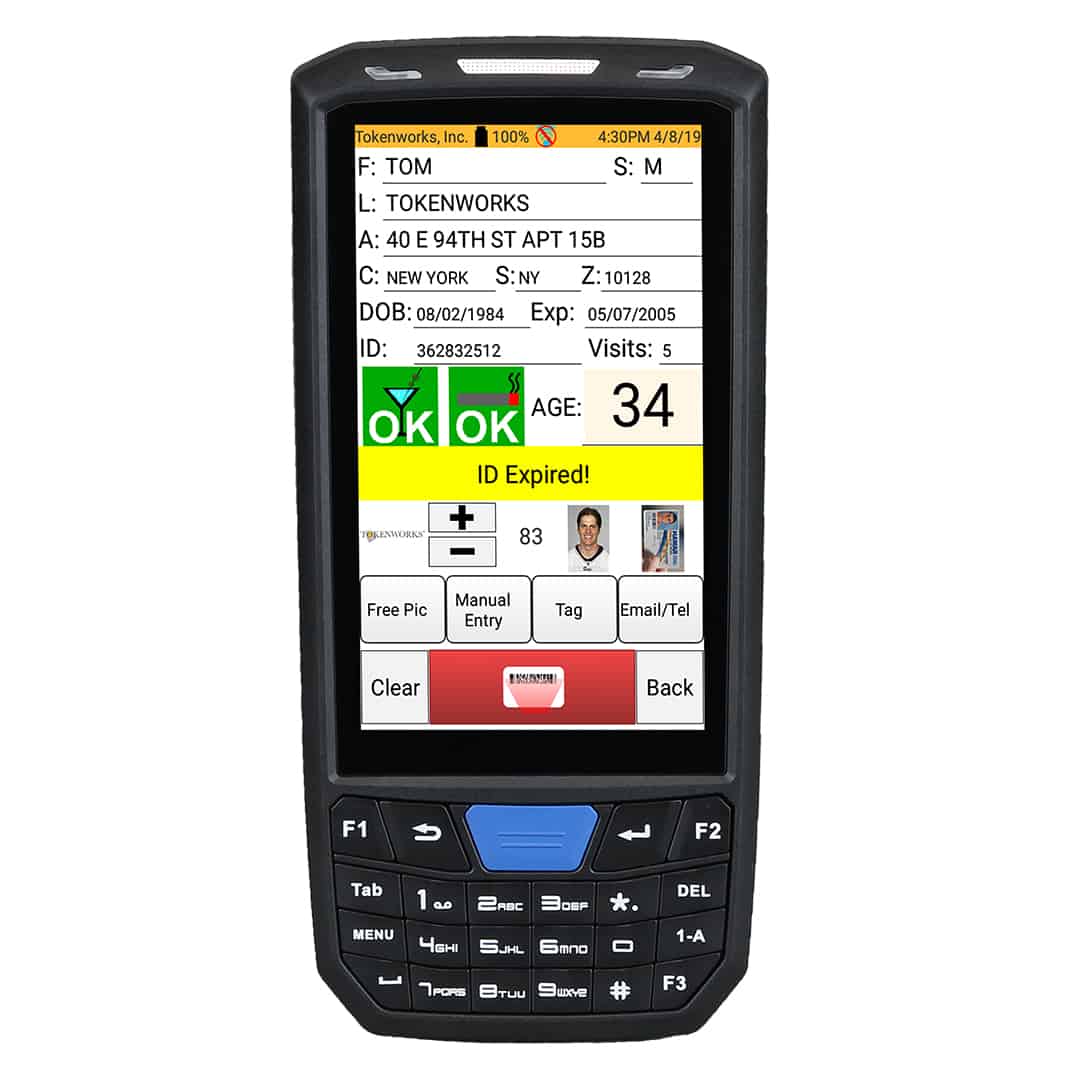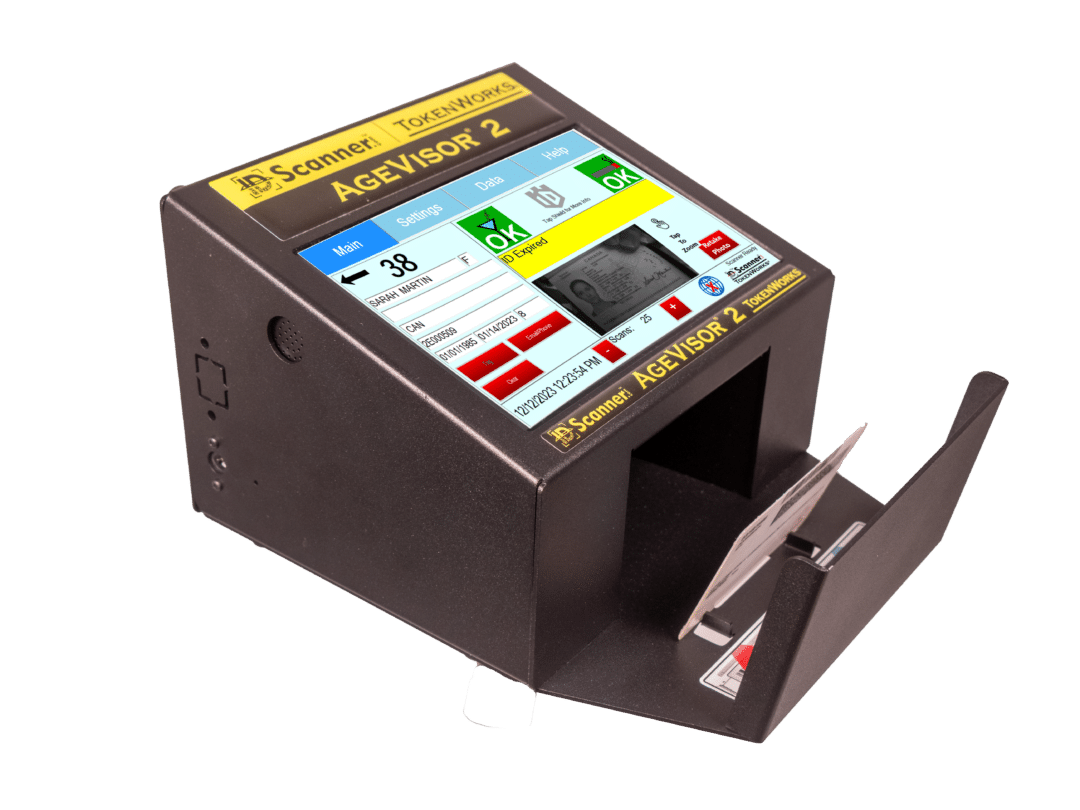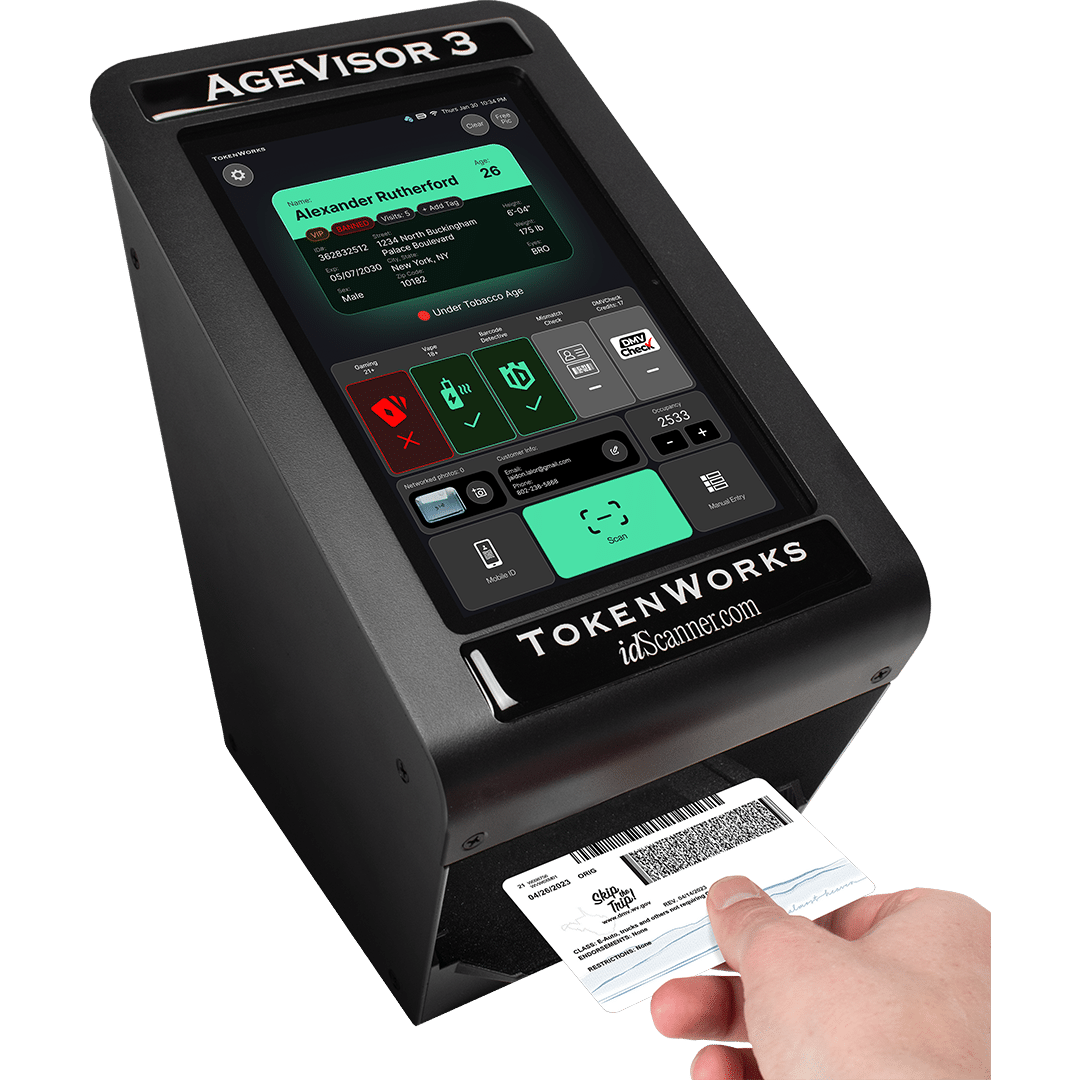


Nevada writes technology-based age verification directly into its laws for two product categories. Since January 1, 2023, tobacco and vape retailers must use scanning technology or an automated, software-based system to verify the age of any customer under 40 (NRS 370.521). Cannabis dispensaries must also verify every customer with an ID scanner approved by the Cannabis Compliance Board (NRS 678B.545). Penalties for tobacco licensees rose sharply in 2024: when an employee sells to someone under 21, the licensee now faces a civil penalty of $2,500 to $10,000 per violation. Alcohol is the exception: Nevada has no scanning requirement and no statutory defense for alcohol sales, which leaves careful ID checks as a bar or store’s best protection.

Nevada makes it a misdemeanor for any person to knowingly sell, give, or otherwise furnish an alcoholic beverage to anyone under 21. The same statute prohibits knowingly leaving alcohol in any place with the intent that a person under 21 will obtain it, and knowingly giving money or anything of value to someone under 21 to buy alcohol.
Any business that sells or serves alcohol in Nevada, including bars, nightclubs, restaurants, hotels, casinos, liquor stores, grocery stores, convenience stores, and event venues. Retail liquor licenses in Nevada are issued at the local level, so cities and counties may add their own ID and licensing requirements.
Any business that sells alcohol online must adopt a written policy to prevent sales to people under 21. The policy must require the delivery person to obtain the signature of someone over 21 at delivery, and shipments must be clearly marked as containing alcohol. Failing to adopt the policy is a misdemeanor punishable by a fine of up to $500.
A proprietor or manager of a saloon who knowingly allows a person under 21 to remain on the premises faces a fine of up to $500. The rule does not apply to establishments that serve alcohol only with regular meals and have dining tables separate from the bar, or to grocery stores and drugstores that do not sell alcohol by the drink.
Nevada state law does not list acceptable forms of identification for alcohol purchases and does not require electronic scanning for alcohol. Local licensing authorities may set their own ID rules as a condition of the license, so check with the city or county that issued yours.
Nevada has no affirmative defense for alcohol sales. There is no statutory protection for sellers who check ID, whether manually or with a scanner.
What Nevada does have is a “knowingly” standard. A seller violates NRS 202.055 only by knowingly furnishing alcohol to someone under 21. That makes the quality and consistency of your ID check the core of your protection. An ID scanner creates a timestamped record showing that an ID was checked, that it read as valid, and that the date of birth showed 21 or older. That record can help show that a sale to a minor with a convincing fake was not a knowing one. For states that do offer a formal scanner-based defense, see our affirmative defense guide.
In counties with a population of 100,000 or more (Clark and Washoe counties, including Las Vegas and Reno), the owner or operator of an establishment that sells alcohol by the drink must ensure that every employee… holds a valid alcohol education card. In Clark County, the requirement also covers stores that sell alcohol in sealed containers for consumption off the premises (NRS 369.620). New hires must complete the training within 30 days, and cards are valid for four years. Smaller counties can opt in by vote of the local governing body. The training covers checking identification, so it works hand in hand with a scanning program.
Whether you run a bar, nightclub, restaurant, hotel, casino, liquor store, grocery store, or convenience store, your alcohol compliance depends on your ID process.
Nevada does not reward ID checks with a statutory defense. Prevention and documentation are your best protection.
Because Nevada requires proof that a sale to a minor was knowing, a scan record showing that you checked an apparently valid ID can make a real difference if a fake ID gets past your staff.
Many convenience stores, grocery stores, liquor stores, and bars that sell alcohol also sell cigarettes or vapes. If yours does, Nevada law already requires scanning technology or an automated, software-based system for tobacco and vape customers under 40. Using the same system for alcohol sales creates one consistent process.
In Clark and Washoe counties, make sure every server, bartender, and security guard holds a current alcohol education card. In Clark County, that includes cashiers at package stores.
Nevada prohibits selling, distributing, or offering to sell cigarettes, cigarette paper, tobacco products, vapor products, alternative nicotine products, or any product made or derived from nicotine to anyone under 21. Nevada’s age of 21 matches the federal Tobacco 21 minimum.
Since January 1, 2023, a seller may not sell cigarettes, cigarette paper, or other tobacco products to anyone under 40 without first verifying age “through enhanced controls that utilize a scanning technology or other automated, software-based system” to confirm the customer is 21 or older. This requirement came from Assembly Bill 360 (2021).
Vapes and nicotine products are covered by this requirement. For NRS 370.521, Nevada defines “other tobacco products” to include any vapor product and any alternative nicotine product (NRS 370.007, 370.0318, 370.440).
The simplest way to comply is to scan every tobacco and vape customer, since staff cannot reliably tell a 38-year-old from a 42-year-old and a missed scan carries its own $100 penalty.
Nevada uses the term “deemed to be in compliance.” A seller is deemed to comply with the under-21 prohibition if, before the sale, the seller:
This safe harbor protects against the underage sale violation. It does not excuse a failure to scan: a seller who reasonably relies on a convincing fake ID but skips the required scan for a customer under 40 still faces the separate $100 scanning penalty.
Retailers must display a notice at the point of sale stating that tobacco, vapor, and nicotine products may not be sold to persons under 21 and that the retailer may ask for proof of age. Cigarettes may not be sold from self-service displays that customers can access without the retailer’s help, except vending machines used in compliance with NRS 202.2494.
The Attorney General’s Tobacco Enforcement Unit and peace officers conduct random inspections, using persons under 21, to test compliance with the underage sales and scanning rules.
Anyone who sells tobacco, vapor, or nicotine products to Nevada consumers online, by phone, or through another electronic network must:
Assembly Bill 471 (2025), effective January 1, 2026, replaced the earlier “public records” standard with the commercial database standard above. The same bill created a state license for remote retail sellers of cigars and pipe tobacco, and a license cannot be issued or renewed unless the seller uses a qualifying third-party age verification service.
Nevada’s cannabis law requires electronic scanning at every sale. Before a cannabis establishment agent sells cannabis or a cannabis product, the agent must verify the customer’s age by checking a government-issued photo ID using an identification scanner approved by the Cannabis Compliance Board to determine the ID’s validity. The Board’s current guidance confirms that all sales, including deliveries, curbside pickup, and drive-through transactions, must use Board-approved scanners, with equipment approvals requested through the facility’s Accela portal. The Board’s regulations, long cited as the Nevada Cannabis Compliance Regulations (NCCR), are now codified in the Nevada Administrative Code at chapters 678A, 678B, and 678D. The retail ID rules formerly at NCCR 7.015 and 7.020 now appear in NAC chapter 678B, with the scanner requirement at NAC 678B.303 and acceptable forms of ID at NAC 678B.306.
Only persons 21 or older (or medical patients with a valid registry card) may enter a cannabis sales facility. A person under 21 who knowingly enters or remains on the premises of an adult-use cannabis establishment faces a fine of up to $500 (NRS 678D.310(6)).
The Board’s February 2026 notice, which replaced its 2022 and 2024 guidance, defines valid ID as an original, government-issued photo ID showing the holder’s photograph, full legal name, and date of birth that is not altered, damaged, or illegible and is unexpired. Acceptable IDs include:
Other foreign driver’s licenses and IDs, such as voter ID cards, shall not be accepted.
An expired U.S. state-issued driver’s license or ID card may be accepted only if it expired no more than two years ago and the customer presents a second document confirming identity. If an ID will not scan or a scanner is temporarily down, the facility must confirm the ID is unexpired, check its physical security features, require a matching secondary photo ID if authenticity cannot be confirmed, and log the verification manually on a standardized checklist.
Knowingly delivering cannabis to a person under 21 is not protected by Nevada’s cannabis exemption from state prosecution, unless the recipient holds a valid medical registry card or the seller demanded and was shown bona fide documentary evidence of the recipient’s age and identity issued by a federal, state, county, or municipal government.
Cannabis Compliance Board regulations may not require an adult-use customer to provide personally identifiable information to a retail store other than government-issued identification to determine age.
Nevada’s cannabis consumption lounges face dual verification. Before allowing a customer into the lounge and before selling any single-use or ready-to-consume cannabis product, an agent must check and authenticate the customer’s government-issued photo ID using a Board-approved identification scanner, and visually inspect the date of birth. Lounges must refuse entry and sales to anyone who cannot produce valid, unexpired ID showing they are 21 or older, and must post signs at every entry point stating that no one under 21 is allowed in the consumption area (NAC 678D.360). These rules were adopted as NCCR 15.015 and 15.020 and took effect July 14, 2022.
At the time of each loan or purchase, a pawnbroker must record the customer’s name, age, street address, the serial number of one piece of positive identification, and a general physical description, along with details of the transaction and the property. The customer must certify in writing the right to pledge or sell the property. Records must be kept as a permanent record open to inspection by law enforcement, and pawnbrokers must provide a daily transcript of transactions to the sheriff or chief of police (NRS 646.030). Pawnbrokers may not accept property from anyone under 18 (NRS 646.060).
Nevada already requires scanning technology or automated age verification for tobacco and vape customers under 40, and a Board-approved ID scanner for cannabis sales. ID scanners help you:
With tobacco licensee penalties now reaching $10,000 per violation, the cost of a scanner is small compared with the cost of a single failed compliance check.
For cannabis, yes. For tobacco and vapes, Nevada requires scanning technology or an automated, software-based system to verify the age of any customer under 40 (NRS 370.521(3)). Cannabis dispensaries and consumption lounges must verify every customer with a Board-approved ID scanner (NRS 678B.545). Nevada does not require scanning for alcohol sales.
No. Nevada has no statutory defense for sellers who check ID before an alcohol sale. The law does require proof that the seller acted knowingly, so a documented ID check can help show you did not act knowingly if a minor uses a convincing fake.
Nevada’s safe harbor. A seller is deemed to be in compliance if they demanded ID, were shown a valid driver’s license, permanent resident card, Tribal ID, or other documentary evidence showing the customer is 21 or older, and reasonably relied on it (NRS 370.521(2)). The seller must still use scanning technology or an automated system for customers under 40.
The law requires scanning or automated verification for anyone under 40. Because age is hard to judge visually, and a missed scan carries its own $100 penalty, the simplest way to comply is to scan every tobacco and vape customer.
Not on the casino floor. The scanning requirement does not apply to face-to-face sales in areas of a casino where persons under 21 are already prohibited from loitering. The exemption is narrow, so casino operators should confirm with counsel which of their retail locations it covers.
Original, unexpired, government-issued photo IDs, including U.S. state driver’s licenses and ID cards, U.S. passports and passport cards, military IDs, Permanent Resident Cards, Tribal IDs, foreign passports recognized by the United States, and Canadian provincial driver’s licenses. Other foreign driver’s licenses are not accepted.
Only a U.S. state-issued driver’s license or ID card that expired no more than two years ago, and only if the customer also presents a second document confirming identity. All other IDs must be current.
The facility must confirm the ID is unexpired, check its security features, require a matching secondary photo ID if authenticity cannot be confirmed, and record the verification on a standardized manual log.
We are not aware of a Nevada statute that limits which ID fields alcohol or tobacco retailers may record from a scan or how long they may keep them. Nevada’s general data security law still applies, as described below. For cannabis, NRS 678D.500 prevents regulators from requiring customers to provide personal information beyond government-issued ID to determine age. Under Nevada’s data security law, a name combined with a driver’s license or ID card number is personal information (NRS 603A.040). Businesses that keep it must use reasonable security measures (NRS 603A.210), notify affected Nevada residents of a breach (NRS 603A.220), and take reasonable measures to destroy the records when no longer kept (NRS 603A.200).
Yes. Sellers shipping to Nevada consumers must verify age through an independent, third-party age verification service using the buyer’s name, date of birth, and address, and must certify annually to the Attorney General that they do so (NRS 202.24935).
Sale or Furnishing of Alcohol to Minors (NRS 202.055)
Makes knowingly selling or furnishing alcohol to anyone under 21 a misdemeanor and requires online alcohol sellers to adopt age verification policies for deliveries. No statutory defense for sellers.
Status: Active
Amended: 2001
Alcohol Awareness Training (NRS 369.630)
Requires employees who sell or serve alcohol, or work security, at establishments in Clark and Washoe counties to complete certified training and hold a valid alcohol education card.
Status: Active
Amended: 2009
Tobacco and Vapor Sales / Scanning Requirement (NRS 370.521)
Prohibits tobacco, vapor, and nicotine sales to anyone under 21, requires scanning technology or an automated, software-based system for customers under 40, and provides a compliance safe harbor for reasonable reliance on valid ID. Licensee penalties range from $2,500 to $10,000.
Status: Active
Amended: 2023
Online and Delivery Sales of Tobacco and Vapor Products (NRS 202.24935)
Requires remote sellers to verify age through an independent third-party age verification service using commercial identity databases and certify compliance annually to the Attorney General.
Cannabis Retail Age Verification (NRS 678B.545; NAC 678B.306)
Requires dispensaries to verify every customer’s age with a Board-approved ID scanner. Board guidance issued February 2026 sets acceptable ID types, expired ID rules, and manual procedures when an ID will not scan.
Status: Active
Cannabis Consumption Lounges (NAC 678D.210, 678D.220)
Requires lounges to scan and authenticate ID before allowing entry and again before each sale, and to refuse anyone without valid ID showing they are 21 or older.
Status: Active
Effective: July 14th, 2022
Important Notes: Nevada writes technology-based age verification into law for two product categories: tobacco and vape retailers must use scanning technology or an automated, software-based system for customers under 40, and cannabis dispensaries and consumption lounges must use a Board-approved ID scanner, with a manual fallback only when an ID will not scan. Alcohol carries no scanning requirement and no statutory defense, so a consistent scanning process gives bars and stores documentation that can help show a sale to a minor with a fake ID was not made knowingly.
IDscanner.com by TokenWorks is not a legal organization, nor should anything on this page constitute legal guidance. It is meant to be a list of resources and helpful links. Please consult your attorney before making any decisions related to scanning IDs in your state.